Introduction
I often asked myself a question: why isn’t my resume shortlisted by big tech companies? Despite having the necessary skills and experience, I found myself facing rejection after rejection. It wasn’t until I delved into the intricacies of modern resume screening processes that I realized the importance of creating an ATS-friendly resume versus a custom resume. Understanding these two approaches and knowing when to use each has been pivotal in my job search strategy. I this article I wanted to share my experiences to the people.
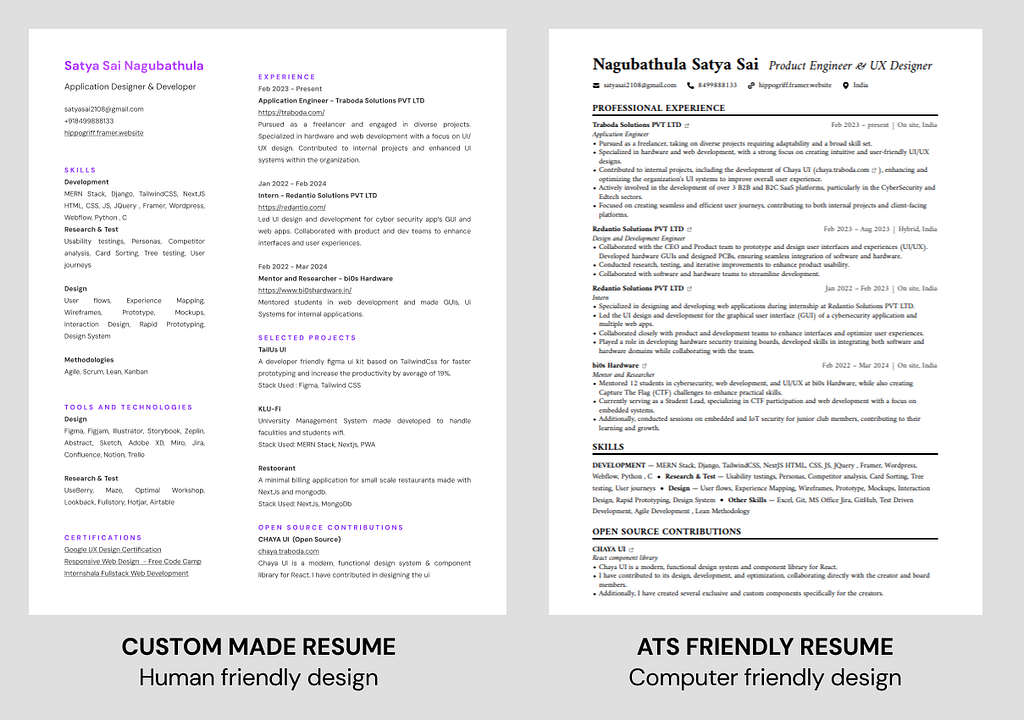
I’m not claiming that my resume is perfect or that it will guarantee me the job. I’m simply sharing a basic example. Ultimately, a resume must be tailored to the specific job description to be effective.
In the competitive job market, your resume is your primary tool for securing an interview. However, job seekers often face the challenge of balancing two critical approaches: creating an ATS-friendly resume and a custom resume tailored to specific job applications. Understanding the differences between these two types of resumes and knowing when to use each can significantly improve your chances of landing your dream job.
What is an ATS-Friendly Resume?
An Applicant Tracking System (ATS) is software used by many companies to streamline the hiring process. ATS helps employers manage large volumes of applications by scanning resumes for specific keywords, skills, and other criteria. To ensure your resume passes through these systems, it must be optimized for ATS.
Key Characteristics of an ATS-Friendly Resume:
- Simple Formatting: Use a clean, standard format without complex layouts, graphics, or tables, which can confuse ATS software.
- Relevant Keywords: Incorporate keywords and phrases from the job description. These should include specific skills, qualifications, and experiences that match the employer’s requirements.
- Standard Fonts: Stick to basic fonts like Arial, Times New Roman, or Calibri. Avoid using fonts that are difficult to read or non-standard.
- Clear Section Headings: Use common headings like “Work Experience,” “Education,” and “Skills.” This helps the ATS parse your information correctly.
- Text-Based Format: Save your resume as a .docx or .pdf file that is text-based. Avoid image-based PDFs, which ATS cannot read.
What is a Custom Resume?
A custom resume is tailored specifically for a particular job or company. This type of resume goes beyond just meeting the basic requirements of ATS and aims to engage human recruiters by showcasing how your background and skills make you the perfect fit for the job.
Key Characteristics of a Custom Resume:
- Targeted Content: Every section of the resume is customized to highlight your most relevant experiences and achievements related to the job you’re applying for.
- Personalized Branding: A custom resume might include a personal branding statement or a professional summary that aligns with the company’s values and culture.
- Enhanced Design: While still professional, a custom resume can use more sophisticated formatting and design elements to stand out visually. However, it should remain easy to read.
- Specific Accomplishments: Highlight specific accomplishments and quantify your achievements with metrics and results that are pertinent to the job.
- Tailored Language: Use language and terminology that resonate with the industry and the specific company, demonstrating your familiarity and alignment with their goals.
ATS-Friendly Resume:
Large Companies: Big corporations, such as Google, Amazon, or Microsoft, often receive thousands of applications for a single job posting. To manage this volume, they rely heavily on ATS to filter out resumes that don’t meet the required criteria.
Suppose you’re applying for a software engineering position at Google. The job description emphasizes experience with Java, Python, and cloud computing. To ensure your resume passes the ATS, you should:
- List “Java” and “Python” in your skills section.
- Mention your experience with “cloud computing” in your work history.
- Use a simple format without graphics or tables to avoid parsing errors.
Initial Application: When applying through online job portals or company websites, especially those that explicitly state the use of ATS, it’s crucial to use an ATS-friendly resume to ensure your application isn’t automatically rejected.
Example: If you apply for a project management role through Lin kedIn, and the job posting highlights experience with “Agile methodologies” and “PMI certification,” make sure these keywords are prominently featured in your resume.
General Applications: When submitting applications to multiple companies in a short period, an ATS-friendly resume can save time while ensuring each application meets the basic criteria for consideration.
Example: You’re a recent graduate looking for entry-level marketing positions. By creating an ATS-friendly resume that includes common keywords like “SEO,” “content marketing,” and “data analysis,” you can apply to several companies efficiently.
Custom Resume
Small to Mid-Sized Companies: These organizations might rely more on human recruiters than on ATS. Customizing your resume to highlight how your experience directly aligns with the company’s needs can make a stronger impression.
Example: You’re applying to a mid-sized startup for a UX designer position. The company’s job description emphasizes a user-centered design approach and proficiency with Figma. Tailor your resume to showcase your most relevant projects, detailing your role in enhancing user experience and your expertise in Figma.
Networking: When applying through a referral or when you have a direct contact within the company, a custom resume can demonstrate your enthusiasm and specific interest in the role.
Example: A friend refers you to a digital marketing position at their company. Knowing the company values innovative content strategies, you create a custom resume that highlights your success in developing viral campaigns and innovative content ideas that align with the company’s brand.
Follow-Up Applications: After passing the initial ATS screening, providing a custom resume can impress hiring managers during the interview stage, showing you’ve taken the time to tailor your application specifically to their needs.
Example: You’ve been invited for an interview at a financial services firm after your ATS-friendly resume was shortlisted. In preparation, you revise your resume to focus on your financial analysis skills, specific achievements like cost-saving measures, and any relevant certifications such as CFA or CPA. This customized version underscores your suitability for the role in a more detailed and personalized manner.
Best Practices
- Hybrid Approach: Combine elements of both ATS-friendly and custom resumes. Start with an ATS-optimized base and then customize it slightly for each application.
- Research: Spend time understanding the job description and the company to better tailor your resume.
- Quality over Quantity: It’s better to apply to fewer jobs with well-crafted resumes than to many jobs with generic ones.
- Test Your Resume: Use online tools to check if your resume is ATS-compatible. This can save you from missing out due to formatting issues.
Conclusion
In today’s job market, knowing when and how to use an ATS-friendly resume versus a custom resume can be a game-changer. By optimizing your resume for ATS, you increase your chances of getting past the initial screening. Meanwhile, a well-crafted custom resume can make a significant impact on hiring managers, demonstrating your genuine interest and suitability for the role. Balancing these strategies effectively can set you on the path to career success.
Originally published on Medium.